How can you find out if a house has flooded before?
Check the flood records kept by the Environment Agency in England and by Natural Resources Wales. They show land that flooded, not whether water got inside, and a gap does not prove a home never flooded.
Our free check looks these records up for a home in either country. Then ask the seller in writing about floods and insurance claims, as you cannot get their claims record yourself. Your surveyor can look for signs of past damage.
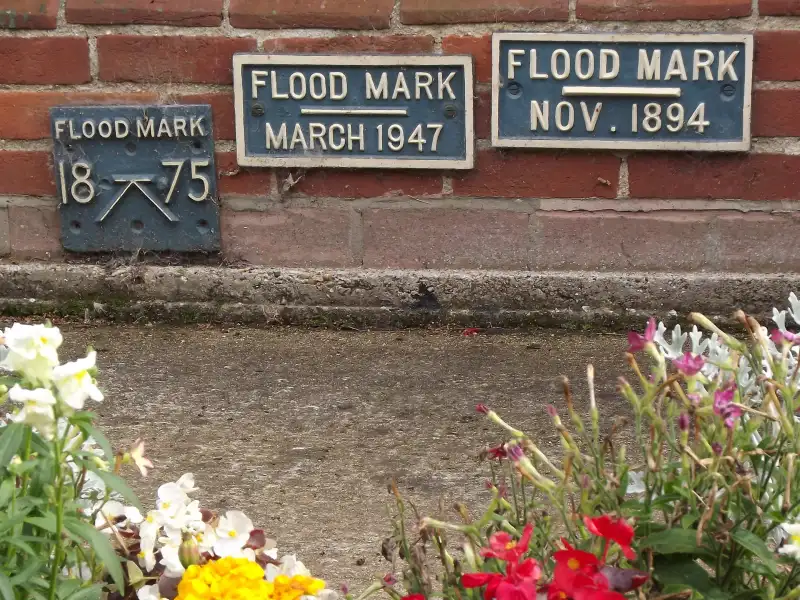

Official records show land, not homes
The Environment Agency’s Recorded Flood Outlines show land in England that has flooded from rivers, the sea, groundwater and surface water. Its records began in 1946, with some details of earlier floods.
In Wales, Natural Resources Wales keeps Recorded Flood Extents for floods from rivers and the sea, and in some places from surface water and small watercourses. It records a flood only where it knows of it and is confident in the record.
Both warn that an outline shows land that flooded, not a building that flooded inside. Neither record is a forecast of future floods.
| Records | England | Wales |
|---|---|---|
| Flood records | 31,744 | 1,223 |
| Most recent flood in the records | January 2026 | November 2025 |
| Postcodes with a recorded flood at their centre point | 2.7% | 2.3% |
Worked out by UK Property Check from the Environment Agency’s Recorded Flood Outlines (September 2026 release) and Natural Resources Wales’s Recorded Flood Extents, loaded on 21 October 2026.
The last row covers 1,430,731 postcodes in England and 89,380 in Wales, for homes and small businesses. Each postcode is placed at its centre point, which makes this a rough guide.
For each recorded flood at the home’s position, our free check shows when it happened, where the water came from when that is known, and any storm named in the record.
Some records name the storm that caused the flood. These are the storms named most often in the records for England and Wales.
| Storm | Flood records naming it |
|---|---|
| Ciara, February 2020 | 129 |
| Babet, October 2023 | 120 |
| Dennis, February 2020 | 87 |
| Bert, November 2024 | 46 |
| Christoph, January 2021 | 42 |
| Dudley and Eunice, February 2022 | 39 |
| Henk, January 2024 | 19 |
| Darragh, December 2024 | 17 |
Worked out by UK Property Check from the same records. Only records whose name mentions the storm are counted. Storm dates are from the Met Office.
If our check shows a flood near the home that names a storm, ask the seller about that storm by name.
Recent floods take months to appear
The Environment Agency updates its records every three months. It says it often takes a number of months to gather the evidence, check it and record a new outline.
The latest flood in our copy of its records is from January 2026, so a flood since then may not be there yet.
Past floods and today’s risk differ
A flood risk level is a model of what could happen. A recorded flood did happen. The two often differ, because defences and drains can change after a flood, and low risk still means up to a 1% chance each year.
In our comparison, 65% of postcodes in England whose centre point sits inside a recorded flood are now rated low risk or below for rivers, the sea and surface water. In Wales it is 84%.
Worked out by UK Property Check for the 38,071 postcodes in England and 2,096 in Wales whose centre point is inside a recorded flood, taking the higher of each one’s current risk levels for rivers and the sea and for surface water, from the Environment Agency’s and Natural Resources Wales’s flood risk maps.
If the risk is high but no flood is recorded, do not read the gap as good news, because the records are incomplete. Read the two together, with our guide to what the flood risk levels mean.
Ask for the area’s flood history
In England, email the Environment Agency at enquiries@environment-agency.gov.uk with the full address and postcode. It sends a flood history for the area around the address within 20 working days.
It may charge a fee, depending on how long the report takes, and it does not hold records for every area. Send the request as soon as your offer is accepted, because 20 working days is about four weeks.
In Wales, open the Flood Risk Assessment Wales map and turn on the recorded flood extents layer. For floods from surface water and small watercourses, Natural Resources Wales says to ask the council.
Search the council’s website for flood investigation reports near the home. County and unitary councils, as lead local flood authorities, investigate floods where they think it necessary and publish the results.
In England, government guidance tells them not to list addresses, so a report may count homes by street or neighbourhood instead. GOV.UK also suggests asking the area’s internal drainage board, if there is one.
For sewer flooding, the drainage and water search says whether the water company lists the home as at risk of flooding from overloaded public sewers.
That list leaves out floods caused by blockages or private drains, and any never reported to the water company. Ask the seller about those directly.
The seller’s form asks about flooding
Most sellers fill in the Law Society’s property information form, the TA6. It asks whether the seller knows of any flooding at the property, or any part of it, and if so when, from what source and which parts flooded.
The form counts land as part of the property. A yes can mean only the garden flooded. It also asks about flood defences fitted to the home, whether insurance has been hard to get, and past buildings insurance claims.
The answers go no further than what the seller knows. Your conveyancer usually sees the form only after your offer is accepted, so ask the seller about flooding before you offer.
Check the home can be insured
Get a buildings insurance quote for the exact address before you exchange contracts. It tells you whether the home can be insured on normal terms while you are still free to walk away.
Answer the insurer’s questions with reasonable care, including anything the seller told you about floods or claims. That is the legal duty on you as a consumer, under the Consumer Insurance (Disclosure and Representations) Act 2012.
You cannot see the seller’s claims history yourself. Insurers share household claims through a database run by MIB, the Motor Insurers’ Bureau, but only the person a record is about, or someone they authorise, can ask MIB for it.
MIB keeps each claim for six years after it closes. Ask the seller to request their record and share it, and to show how any flood claim was settled.
Flood Re, the scheme that helps insurers offer flood cover, has no rule about past floods or claims. It does require the home to have been built before 1 January 2009. The scheme is due to run until 2039.
Look for clues at the viewing
Look low on the walls for tide marks, and for skirting boards newer than the rest. Flood doors, smart air bricks, non-return valves and a sump pump under the floor are flood resilience measures. If you see any, ask why they were fitted.
A surveyor can spot signs of past flood damage and repairs, and our guide explains which survey you need. RICS warns that a search of maps and records is no substitute for a chartered surveyor’s physical inspection.
Our viewing checklist adds flood checks for homes in areas at risk. Neighbours who have lived there longer may remember a flood that never reached the records. Ask them if you get the chance.
Find out how a past flood was put right
If the home has flooded, find out before you offer when it happened, where the water came from, which rooms it reached and what was repaired.
Ask for the repair invoices and any insurance claim, and tell your surveyor about the flood before the visit.
Ask the seller, through the agent
- Has the house, the garden or the road outside ever flooded, and when?
- Which rooms did the water reach, and who did the repairs?
- Can you ask MIB for your claims record and share it?
- Has insurance ever been refused, or offered with a high flood excess?
- Are there flood doors, smart air bricks or valves, and do they stay with the house?
Related questions
Does no recorded flooding mean a house has never flooded?
It means only that nothing was recorded there. Some floods were never reported, and others could not be checked. A blank on England’s Historic Flood Map proves even less, as it leaves out surface water floods.
Can I rely on what the seller says about flooding?
Yes, for what they know, and the form’s notes warn sellers that a misleading answer may lead to a claim for compensation after completion. Ask in writing, and keep the reply.
Can I get a flood history for a single address?
The public flood records only cover areas. For sewer flooding, Thames Water sells a history search for a specific address. Ask your conveyancer whether the local water company offers one.
Sources
- GOV.UK, Find out if your property is in an area that has flooded
- Environment Agency, Recorded Flood Outlines (data.gov.uk)
- Environment Agency, Recorded Flood Outlines dataset documentation, August 2025
- Natural Resources Wales, Recorded Flood Extents
- Natural Resources Wales, Recorded Flood Extents metadata record
- Natural Resources Wales, Understanding your flood risk results
- Natural Resources Wales, Check your flood risk on a map (Flood Risk Assessment Wales)
- GOV.UK, Check your long term flood risk: get flood risk data
- Office for National Statistics, Postcode products
- Law Society, TA6 Property information form (6th edition)
- Law Society, TA6 Property information form (6th edition) explanatory notes
- GOV.UK, Investigating a flood: guidance for lead local flood authorities
- legislation.gov.uk, Flood and Water Management Act 2010, section 19
- Thames Water, Drainage and water search sample report
- Thames Water, Property searches
- legislation.gov.uk, Consumer Insurance (Disclosure and Representations) Act 2012, section 2
- MIB, Resources for insurers and brokers
- MIB, Requesting your data from MIB
- Flood Re, Eligibility criteria
- Flood Re, How does Flood Re work?
- Flood Re, About us
- Environment Agency, Property flood resilience
- RICS, Consumer guide: flooding
- Met Office, UK storm season 2019/20
- Met Office, UK storm season 2020/21
- Met Office, UK storm season 2021/22
- Met Office, UK storm season 2023/24
- Met Office, UK storm season 2024/25